




Industry Verified: Fact-checked and reviewed by an Intellectual Property & Entertainment Law Attorney.
Litigation Economics & IP Strategy
- The Registration Trap: Failing to register your catalog with the US Copyright Office before an infringement occurs permanently legally bars you from claiming up to $150,000 per work in statutory damages.
- Prohibitive Upfront Costs: Federal IP litigation is fundamentally a battle of liquid capital. Standard federal IP attorney retainers require $25,000 to $50,000 strictly upfront, with total trial costs frequently exceeding $500,000.
- The AI Legal Precedent: While major labels secure billions in licensing buyouts and settlements with AI platforms like Suno and Udio, independent artists are forced to rely on fragmented, slow-moving class action lawsuits.
Introduction
Landmark AI Copyright Infringement Cases (2024–2026)
Sony Music & Warner Chappell vs. Anthropic
Major publishers allege Anthropic’s ‘Claude’ AI illegally ingested tens of thousands of copyrighted lyrics and compositions via pirated torrent databases.
UMG, Sony, & RIAA vs. Suno & Udio
The record labels allege “massive scale” copyright infringement by audio-generative AI startups training models on major-label master recordings.
Class Action Authors vs. Anthropic
A federal judge ruled Anthropic utilized 7 million pirated books to train LLMs. This set the massive financial precedent for current music lawsuits.
The year 2026 has reshaped music copyright law forever. Major labels like Universal Music Group (UMG) and Sony Music are engaged in bitter legal battles against AI generators like Suno and Udio. These platforms allegedly ingested millions of copyrighted tracks to train their generative models without permission.
- Introduction
- Understanding the Battlefield: DMCA vs. Federal Litigation
- The Brutal Reality: The Cost of Counsel
- Calculating Loss: Actual Damages vs. Statutory Damages
- The Golden Rule: Pre-Infringement Registration
- Alternative Paths: Licensing Agreements and Class Actions
- The Bottom Line on Music IP
- Frequently Asked Questions
While UMG and Warner secured historic settlements, Sony is still litigating aggressively in federal court. These corporate giants are spending millions on legal fees to protect their exclusive catalogs. However, the realities of intellectual property law look vastly different for independent artists and mid-tier label executives.
In late 2025, independent artists filed massive class action lawsuits against both Suno and Udio. These creators realized that major label settlements only protected major label catalogs. Independent artists were left completely alone to fund their own complex legal defenses.
Protecting your catalog is not just about knowing the law. It requires an acute, realistic understanding of litigation economics. This article breaks down the exact financial metrics every serious music business owner must understand before walking into a courtroom.
Understanding the Battlefield: DMCA vs. Federal Litigation
When a rights holder discovers the unauthorized use of their work, they usually start with a Digital Millennium Copyright Act (DMCA) takedown notice. A DMCA notice is a structured, out-of-court administrative mechanism. It legally forces an internet service provider or platform to quickly remove the infringing content.
Filing a DMCA notice is fast, relatively cheap, and highly effective for immediate damage control. Most independent creators heavily rely on this tool to immediately stop unauthorized distribution. However, a standard DMCA takedown has strict legal limitations:
- It does not award you any financial damages or monetary compensation.
- It does not legally prevent the infringer from uploading the file elsewhere.
- It does not force the infringer to disclose their backend accounting records.
If you want actual financial compensation for the theft of your property, you must file a formal lawsuit in federal court. This transition from a simple administrative takedown to a full federal lawsuit changes the economics drastically. Federal copyright infringement is a matter of exclusive federal jurisdiction.
You cannot simply sue someone for copyright infringement in a local state court. Filing in federal court immediately triggers strict procedural requirements, prolonged discovery phases, and highly technical expert testimonies. Entering federal court without significant liquid capital is a guaranteed path to financial ruin.
If you cannot afford the ensuing legal fees, your cease-and-desist threats carry zero actual weight in the industry. Opposing corporate legal teams will easily identify an underfunded plaintiff. They will force you into expensive procedural motions until you inevitably drop the case.
The Brutal Reality: The Cost of Counsel
Hiring competent legal counsel for federal court is the single largest barrier to entry for independent creators. You absolutely cannot use a general practice lawyer for these complex cases. You must hire a specialized, highly experienced federal IP litigator.
Before a reputable firm will draft your initial complaint, they require an intellectual property attorney retainer. In 2026, standard billing structures for a federal music copyright case look like this:
- Retainer Fees: Ranges from $25,000 to $50,000 paid strictly upfront.
- Junior Associate Rates: Typically bills between $400 and $600 per hour for basic paperwork.
- Senior Partner Rates: Routinely charges between $800 and $1,200 per hour for litigation strategy.
At these premium rates, a $50,000 retainer can completely vanish in the first two months of discovery. The total copyright infringement lawsuit cost for a case that goes to a jury trial frequently exceeds $500,000. These massive commercial litigation costs must be paid strictly out of pocket as they rapidly accrue.
Contingency agreements are incredibly rare in standard music copyright disputes. Lawyers actively avoid contingency fees because proving concrete financial damages in music cases is notoriously difficult. Unless the infringement generated obvious commercial profits, you must pay cash to enforce your rights.
Calculating Loss: Actual Damages vs. Statutory Damages
If you successfully fund a lawsuit and win, the court must determine how much money you are actually owed. Copyright law provides two entirely different methodologies for calculating this final payout. The first methodology is legally known as Actual Damages.
Actual Damages compensate you for the exact monetary loss suffered, plus any net profits the infringer made. In the modern music industry, calculating actual damages is a forensic accounting nightmare. You must concretely prove exactly how much revenue the stolen song generated.
If an AI company illegally trained its model on your catalog, calculating actual damages is practically impossible. Because actual damages are notoriously hard to prove, federal copyright law created a much stronger option. This second option is known as statutory copyright damages.
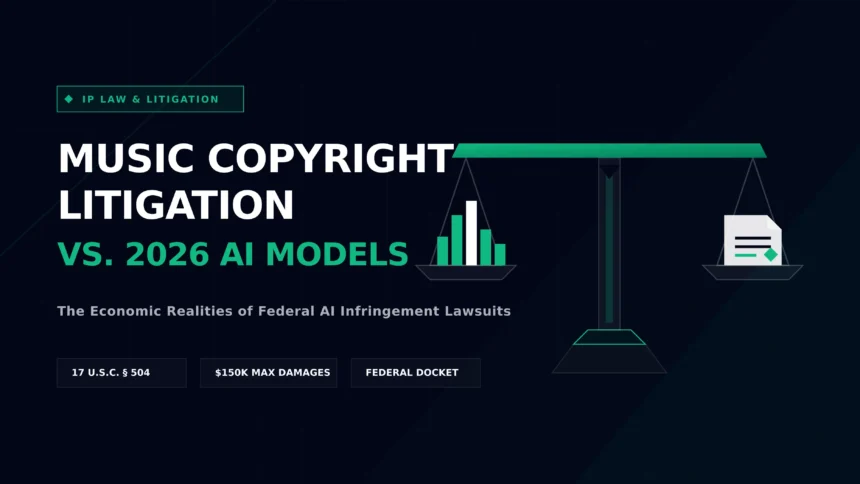
Statutory damages are preset, punitive penalty amounts written directly into federal law. Under 17 U.S.C. Section 504, a judge or jury can arbitrarily award between $750 and $30,000 per infringed work. If you prove the infringement was legally “willful,” the court can dramatically increase that penalty up to $150,000 per work.
This is the exact financial weapon major labels are wielding against platforms like Suno and Udio right now. By claiming millions of ingested tracks, the potential corporate liability quickly reaches the billions. However, there is a massive legal catch that automatically disqualifies most independent artists from ever claiming these penalties.
Federal Litigation Risk & Damages Estimator
Model your potential maximum statutory payout versus estimated out-of-pocket IP attorney costs.
The Golden Rule: Pre-Infringement Registration
The single most critical rule in the music business is thoroughly understanding the power of the US Copyright Office. Your copyright technically exists the moment you record a song and fix it in a tangible medium. However, that automatic, unregistered right is virtually useless in a federal courtroom.
The 17 U.S.C. § 412 Trap
If you file a copyright registration after an AI company or artist has already stolen your work, federal law strictly forbids you from claiming statutory damages or demanding they pay your attorney’s fees. You will be forced to fund a $500,000 lawsuit strictly out of pocket to recover “actual damages”—which are mathematically almost impossible to prove in AI ingestion cases.
To legally claim statutory copyright damages, you must formally register your work with the US Copyright Office before the infringement occurs. If you finally register the work after it has already been stolen, you permanently lose the right to claim any statutory penalties. You are strictly limited to proving actual damages, which is incredibly difficult and inherently expensive.
More importantly, pre-infringement registration officially unlocks your legal right to claim attorney’s fees. If your work is properly registered before the theft, a federal judge can direct the losing party to pay your entire legal bill. This single statutory provision completely changes the underlying economics of music litigation.
If a corporate infringer knows they might ultimately pay your $500,000 legal bill, they will typically settle immediately. If your work is completely unregistered, they will intentionally drag the case out until you go bankrupt. Every independent artist and label executive must audit their catalog and register it immediately.
Registration is cheap, but litigation is expensive. Paying a small government filing fee today can save your entire commercial business tomorrow. Do not wait for a theft to occur before securing your federal rights.
Alternative Paths: Licensing Agreements and Class Actions
Protracted litigation is always a weapon of absolute last resort. Smart music executives consistently focus on proactive commercial monetization rather than reactive, wildly expensive lawsuits. The most effective way to avoid federal court altogether is by establishing a clear, legally binding music sampling licensing agreement.
A well-drafted license dictates the exact financial terms, royalty splits, and strict usage rights upfront. When an AI company or a major artist wants to use your catalog, a negotiated license guarantees predictable revenue. Universal Music Group expertly used this exact strategy in late 2025, converting their Udio lawsuit into a forward-looking licensing partnership.
For independent creators who lack the leverage to negotiate direct corporate licenses, class action lawsuits have become a secondary option. In 2025 and 2026, thousands of independent artists organized massive federal class actions against prominent AI music generators. By strategically pooling their financial resources, these creators bypassed the crushing costs of individual federal litigation.
However, working creators must carefully manage their expectations regarding these massive group lawsuits. Historical legal data clearly shows that class action settlement payouts in the music industry often result in mere pennies on the dollar for individual plaintiffs. The corporate law firms representing the class typically take a massive, prioritized percentage of the final settlement.
Furthermore, these complex class action cases inevitably take years to fully resolve in federal court. You cannot build a sustainable, profitable music business while passively waiting for a settlement check. Your primary focus must relentlessly remain on proactive catalog registration and strict internal IP management.
The Bottom Line on Music IP
Independent creators must view their music catalogs as commercial assets requiring active legal defense. The 2026 AI copyright lawsuits perfectly illustrate that only well-capitalized entities can comfortably survive federal court. If you operate a music business without proper copyright registrations, you are effectively operating without a safety net.
Understand that copyright infringement is fundamentally a financial issue, not just an emotional betrayal. Your ability to punish a thief depends entirely on your legal leverage and liquid capital. Register your works, draft clear contracts, and heavily avoid federal litigation whenever possible.
Frequently Asked Questions
Q: Can I recover my legal fees if I win a music copyright infringement lawsuit?
Yes, but only if you followed strict federal filing procedures. Under 17 U.S.C. § 412, a federal judge can only force the infringing party to pay your intellectual property attorney fees if your music catalog was formally registered with the US Copyright Office before the infringement occurred (or within three months of the work’s initial publication).
Q: What happens if an AI platform uses my song for model training without a license?
If an AI platform ingests your copyrighted masters or compositions without a music sampling licensing agreement, it constitutes unauthorized commercial use. If your works are properly registered, you can sue the platform in federal court for statutory copyright damages, which can reach up to $150,000 per infringed work for willful commercial theft.
Q: Is a DMCA takedown notice sufficient to claim financial compensation for music copyright theft?
No. A DMCA takedown is strictly an out-of-court administrative tool used to force platforms (like YouTube or Spotify) to quickly remove stolen content. It does not award financial compensation or trigger class action settlement payouts. To recover monetary losses or statutory damages, you must file a formal commercial litigation lawsuit in federal court.
Editorial & Legal Disclosure: The legal and financial analysis provided on AfroMag is for educational and informational purposes only and does not constitute formal legal counsel or establish an attorney-client relationship. Intellectual property laws and federal litigation procedures vary by jurisdiction; readers should consult a licensed IP attorney before initiating legal action or making commercial licensing decisions. AfroMag is an independent publisher monetized through programmatic advertising (such as Google AdSense). Our editorial coverage remains strictly independent and uninfluenced by commercial partners.