



Industry Verified: Fact-checked and reviewed by a Commercial Liability & Risk Management Specialist.
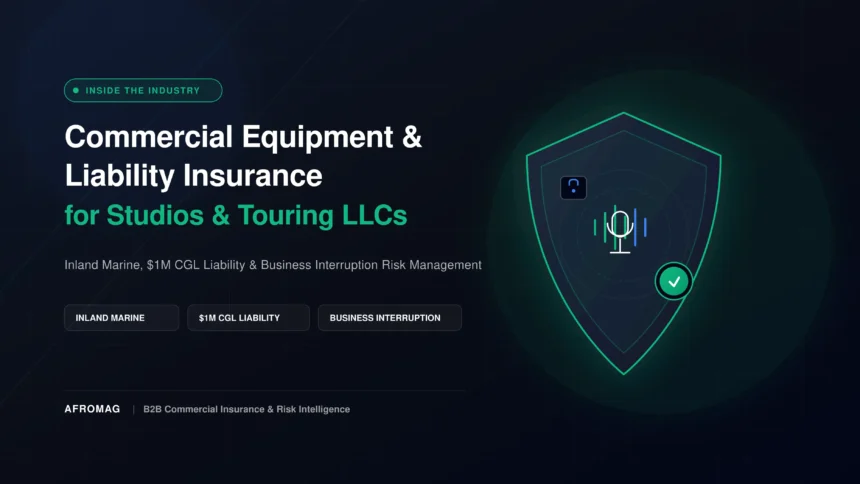
You run a music business, not a hobby. Whether you operate a commercial recording studio or manage a touring LLC, your equipment and legal exposures are massive. Protecting these assets requires specialized commercial coverage.
- What is an Inland Marine Policy?
- Setting Your Scheduled Property Limit
- Understanding Commercial General Liability (CGL)
- How Liability Claims Work
- The Role of Business Interruption Insurance
- B2B Policy Underwriting Explained
- Choosing the Right Deductible
- Getting a Commercial Equipment Insurance Quote
- Frequently Asked Questions
Many gigging musicians and studio owners make a catastrophic financial mistake early in their careers. They rely on standard homeowners or renters insurance to cover their gear. This is a massive risk.
Personal insurance policies explicitly exclude coverage for business activities. If you earn money using your equipment, personal policies will not pay out for a loss. If a vintage synthesizer is stolen from your commercial studio, a homeowners policy will deny the claim.
The same rule applies to touring bands. If your gear trailer gets stolen from a hotel parking lot, your personal auto or renters insurance will not help. The insurance adjuster will classify the loss as a business exposure.
Treat your studio or tour like a formal business entity. A denied claim can bankrupt a touring LLC or force a recording studio to close its doors permanently. You need commercial coverage designed specifically for the music industry.
What is an Inland Marine Policy?
Most commercial property insurance only covers items inside a specific building. However, the music industry requires constant movement. This is where an Inland Marine policy becomes critical.
An Inland Marine policy covers portable business property wherever it goes. It protects your musical instruments, audio interfaces, microphones, and staging gear while in transit. It also covers your gear while temporarily stored at venues, rehearsal spaces, or hotels.
This coverage protects against theft, fire, water damage, and accidental damage. Dropping a $5,000 tube microphone during load-in is exactly the type of incident this policy covers. It fills the severe protection gaps left by standard commercial property insurance.
Touring LLCs should never put a vehicle on the road without this coverage. The risks of trailer theft and transit damage are simply too high. This policy guarantees that your movable assets are financially protected across state lines and international borders.
Setting Your Scheduled Property Limit
When setting up your coverage, you must accurately value your gear. Insurance companies will ask you to create a detailed inventory list. This list directly determines your scheduled property limit.
A scheduled property limit is the maximum amount the insurance company will pay for specific, itemized pieces of gear. High-value items like vintage guitars, mixing consoles, or grand pianos must be individually listed on your policy. You must provide the make, model, serial number, and replacement value for each specific item.
Do not guess the value of your equipment. Use recent purchase receipts or formal appraisals to determine accurate replacement costs. Under-insuring your gear means you will not have enough money to buy an equivalent replacement after a total loss.
Smaller items like cables, drumsticks, or generic microphone stands can often be grouped together under a blanket coverage limit. However, your most expensive assets must always be specifically scheduled. Keeping this inventory updated is your responsibility as a business owner.
Understanding Commercial General Liability (CGL)
Physical gear is only one part of your business risk. You also face severe legal risks every time you interact with the public. Commercial General Liability (CGL) protects your business from third-party lawsuits.
Venues, festivals, and corporate clients almost always require you to carry CGL. They will ask for a Certificate of Insurance (COI) before you can load in. This policy includes essential public liability coverage.
Public liability coverage pays for medical expenses and legal judgments if your business injures someone or damages their property. For example, imagine a fan trips over your unsecured speaker cable and breaks their wrist. The fan can sue your touring LLC for medical bills and lost wages.
If a heavy lighting rig falls and damages a venue’s custom stage floor, CGL covers the repair costs. Without this policy, you would have to pay these costs out of your own pocket. A single lawsuit can easily exceed hundreds of thousands of dollars.
How Liability Claims Work
Filing a liability claim is a stressful process for any business owner. When an incident occurs, you must notify your insurance broker immediately. Delaying this notification can result in a denied claim.
Once you report the incident, the insurance company assigns an adjuster to investigate the facts. Do not admit fault at the scene of an accident. Let the insurance adjuster gather the evidence and handle the communication with the injured party.
The most valuable aspect of your CGL policy is the legal defense provision. If you are sued, the insurance company hires and pays for the lawyers to defend your LLC. These legal defense costs are often paid outside of your main policy limits.
Even a frivolous lawsuit can cost tens of thousands of dollars in attorney fees to get dismissed. A liability claim defense can save your business from bankruptcy. The insurance carrier fights the legal battle so you can focus on running your business.
The Role of Business Interruption Insurance
Physical damage to a recording studio stops your ability to generate revenue. If a pipe bursts and floods your live room, you cannot record clients. Repairing the damage might take three months.
During those three months, you still have bills to pay. You must pay commercial rent, equipment loans, and employee salaries. This is exactly why studios need business interruption insurance.
Business interruption insurance replaces your lost net income during a covered shutdown. It calculates what your business would have earned based on your historical financial records. It also covers your ongoing fixed expenses while the doors are closed.
This coverage ensures you do not have to lay off your audio engineers or default on your lease. It bridges the financial gap until your studio is fully operational again. Touring LLCs can also structure similar policies to cover guaranteed tour income lost due to catastrophic gear destruction.
B2B Policy Underwriting Explained
Insurance companies do not hand out policies blindly. Every application goes through a strict evaluation process. This evaluation process is known as B2B policy underwriting.
Underwriters assess the specific risks associated with your studio or tour. They look at your touring radius, the types of venues you play, and your historical claims record. A band playing acoustic sets at local coffee shops represents a much lower risk than a heavy metal tour using live pyrotechnics.
Underwriters will also examine your security protocols. They want to know if your studio has central station burglar alarms and sprinkler systems. For touring bands, they will ask how gear is secured overnight and who drives the transport vehicles.
If you have a history of frequent claims, underwriters will charge you higher premiums. They may also require you to implement specific risk management procedures before they approve the policy. Being entirely transparent during the B2B policy underwriting process prevents claim denials later.
Commercial Studio & Touring Insurance Estimator
Estimate your annual and monthly premium for combined Inland Marine (Gear) and Commercial General Liability (CGL) coverage.
Choosing the Right Deductible
Every commercial insurance policy includes an out-of-pocket financial requirement. A deductible is the amount of money your business must pay before the insurance company steps in. You must choose this amount carefully when structuring your policy.
If you select a $1,000 deductible, you are responsible for the first $1,000 of any approved claim. The insurance carrier pays the remaining balance up to your policy limits. Higher deductibles result in lower monthly premium costs.
Lower deductibles make your monthly premiums more expensive. As a business owner, you must balance your monthly cash flow with your emergency cash reserves. Do not choose a high deductible if your LLC cannot comfortably afford to pay it during a crisis.
Many touring LLCs opt for higher deductibles to save on upfront premium costs. They accept the risk of paying a larger chunk out of pocket for minor damage. They rely on the insurance purely for catastrophic, business-ending losses.
Getting a Commercial Equipment Insurance Quote
Do not wait until a tour starts or a studio opens to look for insurance. The process requires documentation, strategic planning, and underwriting time. Start gathering your equipment lists, venue contracts, and financial records early.
You need to work with a broker who deeply understands the entertainment industry. Generic commercial brokers may not understand the nuances of a recording studio’s layout or a band’s touring schedule. Specialized brokers know exactly which carriers offer the best terms for musicians.
When you are ready, contact a specialized broker to request a commercial equipment insurance quote. Provide them with your complete scheduled property inventory and your touring itinerary. Be honest about your revenue projections and your actual risk exposures.
Compare multiple quotes to ensure you get the best rates and coverage limits. Read the policy exclusions carefully so you know exactly what is not covered. Treat your insurance policy as a foundational business asset that secures your long-term financial future in the music industry.
Frequently Asked Questions
Will my renters insurance cover studio gear stolen from a gig venue?
No. Standard renters and homeowners insurance policies strictly contain business use exclusions. The moment you generate income using your instruments or gear, personal insurance drops coverage to zero for business-related losses.
What is a Certificate of Insurance (COI) and why do venues require it?
A Certificate of Insurance (COI) is an official document issued by your insurance broker proving you carry active Commercial General Liability (CGL). Venues require this to protect themselves from financial liability if your band causes property damage or injury on site.
What is the difference between Actual Cash Value and Replacement Cost?
Actual Cash Value pays out the depreciated market value of old or used equipment at the time of loss. Replacement Cost pays what it actually costs to buy brand-new equivalent equipment today, eliminating out-of-pocket expenses for upgrades or replacements.
Editorial & Advertising Disclosure: The information provided on AfroMag is for educational and informational purposes only and does not constitute professional financial, legal, or insurance advice. While we strive to provide accurate and up-to-date information, readers should consult with a licensed commercial insurance broker or financial advisor before making any purchasing or investment decisions. AfroMag is an independent publisher and may earn revenue through programmatic advertising (such as Google AdSense). Our editorial content is strictly independent and is not influenced by our advertising partners.